UN Human Rights Advisor Lectures ILPD Students on Rights-Based Justice
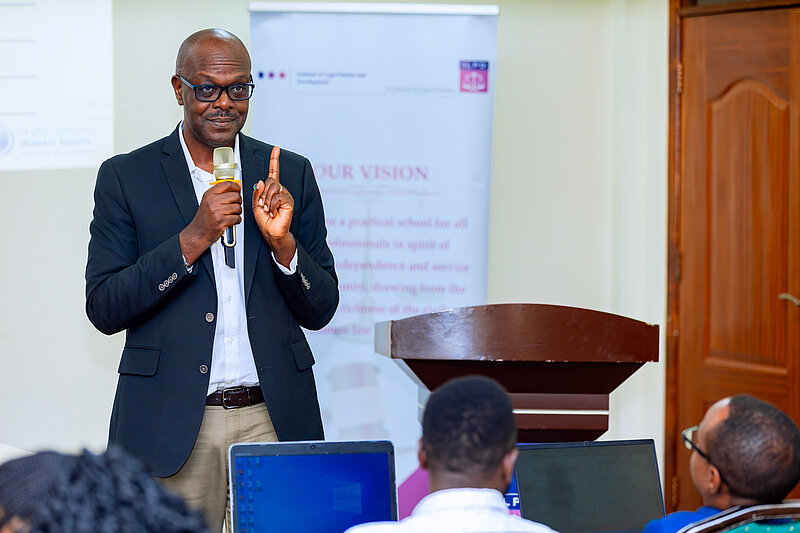
October 16, 2026, Michael Ngabirano, a Senior Human Rights Advisor at the United Nations Office of the High Commissioner for Human Rights (OHCHR), delivered a public lecture on human rights-based justice at the Institute of Legal Practice and Development (ILPD).
ILPD trains legal professionals who go on to serve as judges, prosecutors, advocates, and other legal practitioners.
During his presentation, Ngabirano introduced students to international human rights law, with particular emphasis on United Nations human rights treaties and African Union instruments relating to human and peoples’ rights. He stressed that all legal professionals share the responsibility of understanding and implementing both national laws and international human rights instruments.
He further explained that the effective protection of human rights at the national level depends on the independence and capacity of key justice institutions, particularly the judiciary, prosecution services, and the legal profession, to understand and uphold human rights standards.
Ngabirano noted that the primary responsibility of courts is to interpret and apply the law. Therefore, to deliver well-reasoned judgments and ensure the proper administration of justice, courts must have a sound understanding of the fundamental rights guaranteed under international law.
He reminded students that the International Covenant on Civil and Political Rights (ICCPR) guarantees everyone the right to liberty and security of person.
“No one should be arbitrarily arrested or deprived of their liberty in violation of the law,” he said.
He identified arbitrary arrest and detention as persistent challenges facing the international community. He highlighted that Article 9(1) of the ICCPR, Article 6 of the African Charter on Human and Peoples’ Rights, and Article 24 of the Constitution of Rwanda provide safeguards against unlawful arrest and detention and protect the right to liberty and security of person.
Ngabirano underscored that detention should be a measure of last resort, applied only when alternative measures have been considered and found insufficient.
Citing the ICCPR’s requirement that anyone arrested be promptly informed of the reasons for their arrest and any charges against them, he highlighted the important role of defense lawyers in protecting the rights of accused persons. He urged them to remind their clients of their right not to incriminate themselves and their right to be treated with dignity from the moment of arrest.
He also encouraged defense lawyers to seek timely judicial intervention whenever investigative or prosecutorial authorities violate the rights of suspects and accused persons.
Addressing the role of prosecutors, Ngabirano urged them to initiate criminal proceedings only when sufficient evidence, obtained through lawful means, is available. He further called on them to respect legally prescribed periods of pre-trial detention and to promptly disclose any exculpatory evidence to the defense.
He added that courts have a duty to scrutinize the legality of every detention, deliver well-reasoned decisions, and refrain from relying on evidence obtained in violation of the rights of accused persons.
An ILPD student, Twahirwa Uwanjye Benitha, said that the lecture had provided valuable insights into international human rights law, particularly on how she and her peers would apply this knowledge in their future roles as judges, prosecutors, and advocates.
“We were taught that a person suspected of committing an offense must not have their rights violated before being found guilty. Even when someone has been convicted, their rights must continue to be respected, including while serving a sentence in a correctional facility,” she said.
The Vice Rector for Academics at ILPD, Dr. Yves Sezirahiga, explained that the Institute brings together students at different stages of their academic journey, including newly admitted students, continuing students, and those approaching graduation. He said all of them need to understand the legal provisions governing individual rights and the importance of protecting human rights in the administration of justice.
“Whether they are going to become judges, prosecutors, or advocates, they must understand what the law provides regarding human rights and how these rights should be respected. That is why we organized this lecture to equip them with the necessary knowledge and understanding so that they can put these principles into practice. That is precisely what we expect of them,” he said.
In addition to Rwandan students, ILPD attracts legal professionals from across Africa. Many of its international students currently come from The Gambia, Cameroon, South Sudan, Nigeria, Uganda, Burundi, and the Democratic Republic of the Congo.