ILPD Highlights Role of ADR in Reducing Court Backlogs

The Institute of Legal Practice and Development (ILPD) has underscored the role of Alternative Dispute Resolution (ADR) in reducing court backlogs and prison overcrowding, calling for stronger mechanisms that promote the amicable settlement of disputes.
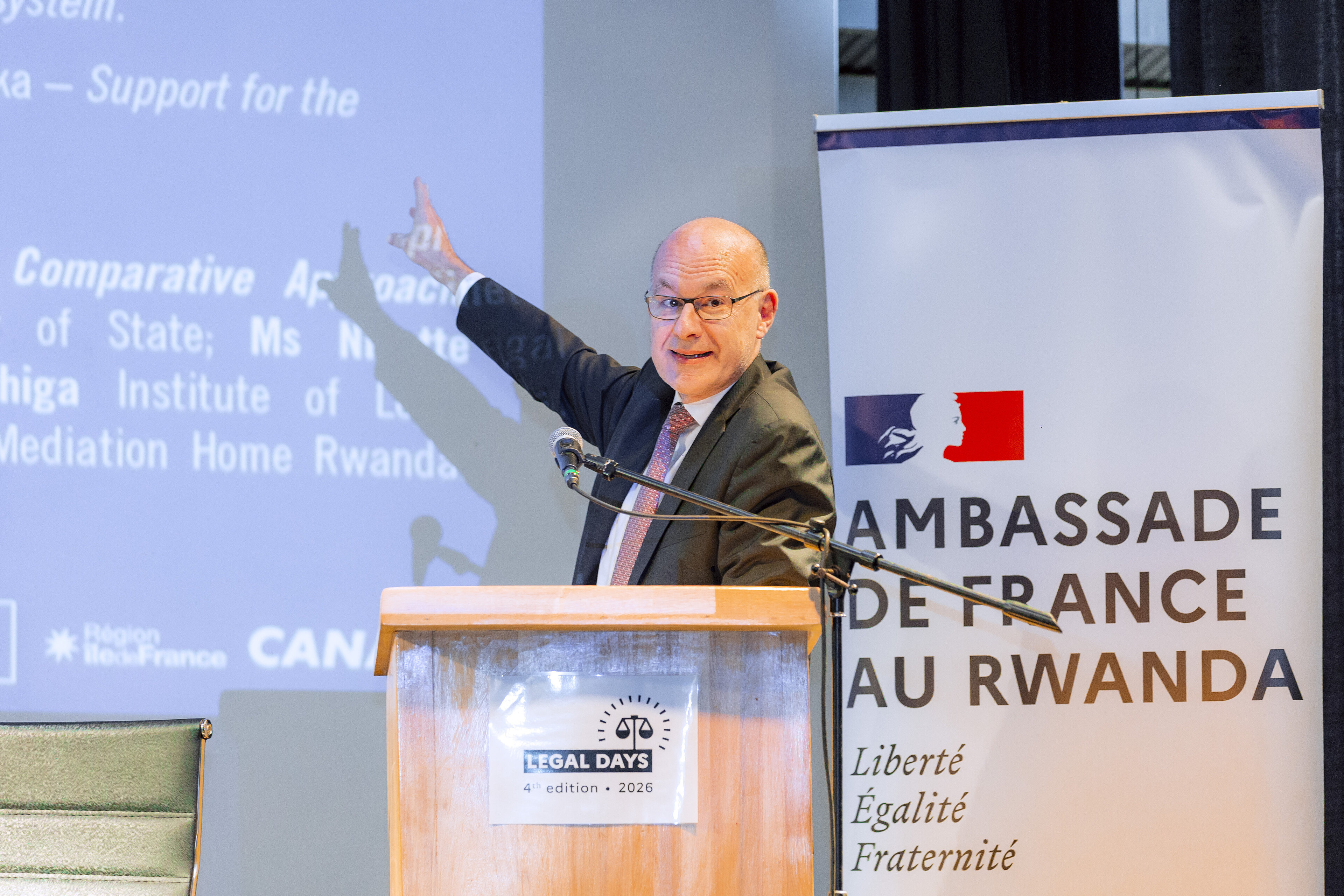
The message was delivered on 29 October 2026 during a meeting between ILPD and the Embassy of France in Rwanda, which explored ways to further strengthen the justice sector.
ILPD Vice Rector in charge of Academics, Dr. Yves Sezirahiga, said research conducted by the Institute had informed several policies, including the Alternative Justice Policy, commonly known as the Ubutabera Nsanasano Justice Policy, adopted in 2022. He explained that the policy has helped address some of the longstanding challenges facing the justice sector.
He pointed out that considerable progress has been made in reducing court backlogs since the policy’s implementation, although further efforts are needed to achieve its targets.
“When the policy was introduced in 2022, the court backlog rate stood at over 60%. By 2025, it had dropped to 47%. According to the latest report, published in July this year, the rate had further declined to 42%. Our target is to bring it down to 30% by 2029,” he said.
Dr Sezirahiga also highlighted improvements in prison conditions.
“Another important indicator is prison overcrowding. When the policy was introduced, the overcrowding rate stood at 140%. Today, it has declined to 97.2%. While these improvements cannot be attributed solely to the policy, our ongoing research demonstrates that it has made a significant contribution,” he added.
He stressed that sustaining this progress will require strengthening the mandate of Abunzi Committees (community mediation committees) so they can handle a broader range of disputes.
He also proposed that certain categories of disputes be required to go through Abunzi Committees before being referred to formal courts. This, he said, would reduce the number of cases brought before courts while fostering a stronger culture of dialogue and consensual dispute resolution.
“The advantage of resolving disputes through these mechanisms is that the outcome is based on an agreement reached by both parties. This eliminates the need for an appeal and allows both parties to leave satisfied. This is unlike a court judgment, where one party wins and the other loses,” he explained.
So far, ILPD has trained 1,243 professionals from various institutions and organisations involved in implementing the Nsanasano Justice Policy. The policy promotes several ADR mechanisms, including mediation, victim-offender mediation and plea bargaining. Through these, ILPD seeks to reduce the number of cases referred to formal courts, enable citizens to resolve disputes amicably, and help ease prison overcrowding and court backlogs.
Yves Gounin, a French justice sector expert, noted that ADR is also gaining recognition in France as an effective way of resolving disputes.
“In France, access to justice is free, but people still need legal representation, and lawyers can be expensive. Alternative Dispute Resolution helps people avoid these additional costs and saves them time, as they do not have to spend long periods engaged in litigation or waiting for court decisions,” he said.
The Ambassador of France to Rwanda, H.E. Aurélie Royet-Gounin, commended Rwanda for its progress in promoting ADR, describing it as an effective approach to fostering dialogue and the peaceful resolution of disputes among citizens.
“We felt that if we were going to discuss the role of Abunzi Committees, it was important to demonstrate our support for them. That is why, in partnership with Haguruka, a Rwandan organisation promoting women’s rights, we supported capacity-building training for Abunzi Committee members in Ruhango District, which took place recently,” she said.
She further emphasised the role of Abunzi Committees in improving access to justice, particularly for women.
“We believe that Abunzi Committees play an important role in improving women’s access to justice. This is an issue we attach great importance to, and, as you know, promoting gender equality and women’s rights is one of the key priorities of our foreign policy,” she stated.